The European Union’s Clean Industrial Deal (CID) represents a key moment in the continent’s industrial transformation, promising to reshape how businesses approach sustainability while maintaining competitive advantage. AIS Environment recently had the privilege of participating as panelists in a webinar examining this groundbreaking initiative, offering us valuable insights into both its opportunities and challenges.
Understanding the EU Clean Industrial Deal (CID)
The CID comes as a response to rising geopolitical tensions, slow economic growth, and intensifying technological competition. With ambitious targets to mobilise over €100 billion in funding, this deal addresses critical challenges: industrial competitiveness in a 450-million consumer market, accelerated decarbonisation (the EU must reach 55% emission reductions by 2030), energy security amid prices double those in the US, and strategic autonomy following Russia’s weaponisation of gas supplies.
The deal’s six core drivers—affordable energy, lead markets, financing, circular economy, global partnerships, and skills development—aim to transform energy-intensive industries while positioning Europe as a clean-tech manufacturing leader. Key performance indicators include increasing electrification rates from 21.3% to 32% by 2030, installing 100 GW of renewable energy capacity annually, and achieving 40% domestic production of clean technology components.
Key Industry Questions and Our Analysis
During the panel discussion, several critical questions emerged that reflect the concerns and aspirations of businesses across Europe. Here are some of our responses on the practical implications of these industrial policies for Malta:
The Synergy Between Sustainability and Competitiveness
We emphasised that the Clean Industrial Deal utilises sustainability as a tool for economic growth, recognising that resource efficiency—whether raw materials, energy, or water—directly translates to cost savings and competitive advantage. However, with 94% of Maltese companies being small or micro enterprises, accessing the necessary resources and funding remains challenging. This reinforces the critical role of environmental consultants like AIS Environment in bridging the gap between ambitious policy goals and practical implementation.
Environmental Impact Assessments and Permitting
The CID builds upon existing frameworks that have already shortened solar permitting to three months, with the proposed Industrial Decarbonisation Accelerator Act set to further streamline processes. Our approach advocates for integrating environmental considerations during the design phase rather than as an afterthought, working hand-in-hand with project developers to avoid costly redesigns and timeline disruptions.
Funding Accessibility
We stressed that strong funding requires not just availability of realistic funds, but improved ease of access. One standout moment was the metaphor used to describe the relationship between funding and the Corporate Industry Dialogue (CID). It was likened to the foundations of the Portomaso Tower—without a solid financial base, the tower (or in this case, the CID) risks collapse. Just as no building can rise without structural support, the CID cannot succeed without robust investment in the private sector.
Real-Time Insights from the Discussion
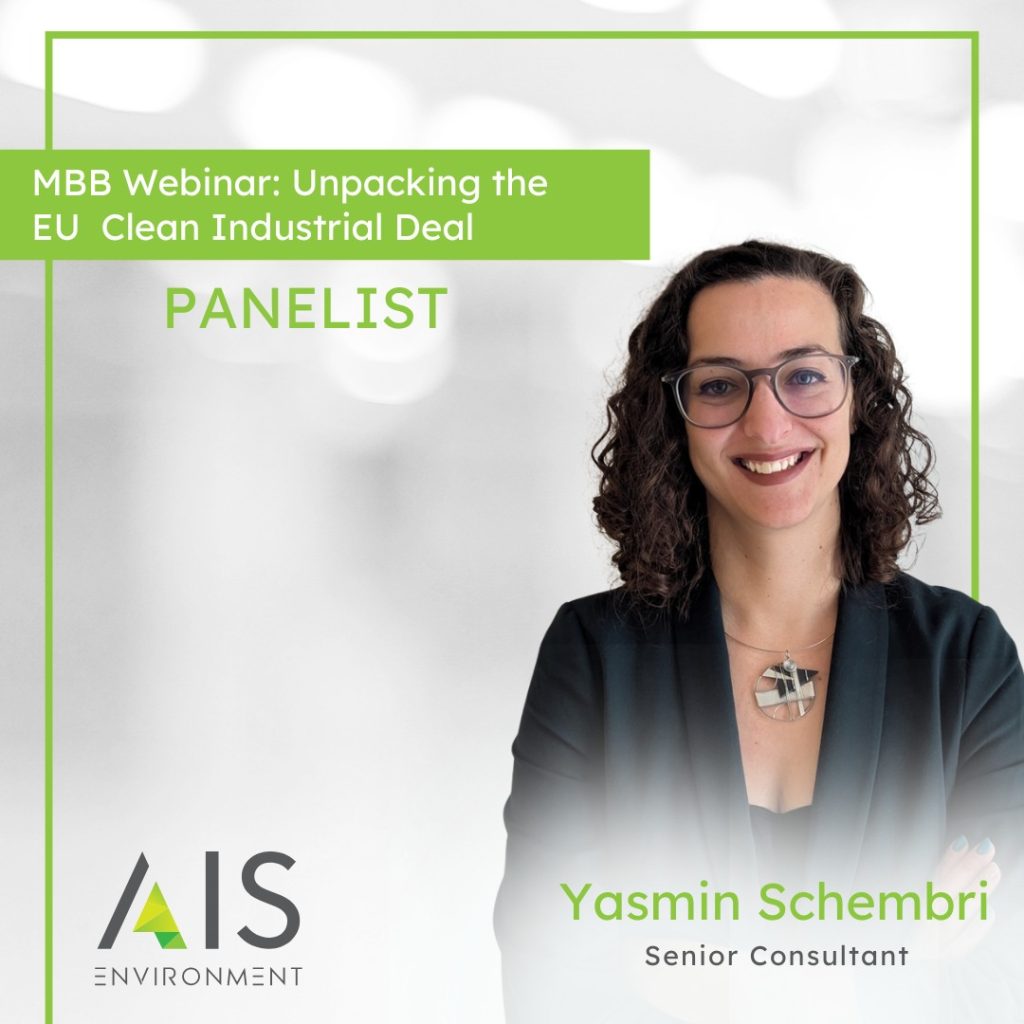
At AIS Environment, we were pleased to be invited by Malta Business Bureau to participate in a timely and engaging webinar exploring the current state of play for the Corporate Sustainability Due Diligence Directive (CSDDD) and its implications for Malta’s private sector.
The webinar provided a dynamic platform for real-time engagement, with participants sharing diverse perspectives on implementation challenges and opportunities. Yasmin Schembri, Senior Consultant at AIS Environment, contributed valuable insights during the discussion. Our comprehensive analysis identified several critical observations:
Technology Readiness and Market Potential
For Malta’s specific context, established technologies like PV panels, battery storage, and heat pumps remain the most viable immediate solutions. However, emerging opportunities in smart energy systems with IoT sensors, rainwater harvesting (particularly relevant given Malta’s 175 million m³ annual rainfall versus 35 million m³ current water production), and waste-to-resource technologies present compelling long-term prospects.
Critical Implementation Barriers
Malta faces unique challenges, including scale limitations due to its small domestic market, the current energy subsidy regime that extends return-on-investment timelines, and resource constraints particularly affecting SMEs. The government’s €165 million annual electricity subsidies, while socially important, inadvertently discourage clean technology adoption by reducing financial incentives for efficiency investments.
Essential Support Services
Three consultancy areas emerge as critical for the successful implementation of this deal:
- Comprehensive environmental impact assessments (EIAs) and appropriate assessments during permitting.
- Sustainable resource and waste management planning with ongoing monitoring.
- Regulatory navigation support to access the CID’s funding mechanisms, including the Innovation Fund and InvestEU programmes.
These discussions reinforced our belief that successful implementation of the Clean Industrial Deal will require nuanced, sector-specific approaches, rather than one-size-fits-all solutions.
Strategic Implications for Malta and Beyond
As a Mediterranean hub with growing industrial capabilities, Malta presents unique opportunities within this EU framework. The Clean Industrial Deal’s emphasis on regional strengths aligns well with Malta’s strategic position, particularly through initiatives like the Trans-Mediterranean Energy and Clean Tech Cooperation Initiative.
Small islands like Malta face unique challenges in scaling industrial transformation. Rather than seeing Malta’s size as a limitation, our analysis highlights the potential for strategic redirection of investment. Specifically, the €165 million currently allocated to energy subsidies could be more effectively used to support SME clean technology adoption and research initiatives. While these subsidies have helped buffer businesses from energy price volatility, the EU is increasingly urging Malta to phase them out. A clear and gradual transition plan is essential, allowing businesses to anticipate and manage future overheads more effectively.
The CID’s circular economy targets—increasing circular material use from 11.8% to 24% by 2030—present particular opportunities for innovative waste-to-resource projects, while the focus on green hydrogen and sustainable maritime technologies aligns with Malta’s shipping and logistics strengths.
Moving Forward Together
The EU Clean Industrial Deal comes as a comprehensive reimagining of European industrial strategy for the 21st century. While challenges remain, particularly around implementation timelines and resource allocation, there is great potential for sustainable industrial growth.
At AIS Environment, we believe success will depend on collaborative approaches that combine regulatory compliance with innovative business solutions. The transition requires not just policy understanding, but strategic implementation that considers each organisation’s unique circumstances and market position.
Ready to navigate the Clean Industrial Deal’s implications for your business? Get in touch with AIS Environment to continue the conversation and explore tailored solutions for your organisation’s clean industrial transition.